

27 Mar What your company does not see when managing waste (and why it is a real risk)
When a company talks about waste management, it usually thinks of a simple process: storing, collecting and removing waste.
But reality is different.
Waste management does not end when waste leaves your facilities. That is where the most important part begins.
Because what happens next — and what remains unseen — is what truly defines whether your company is managing waste correctly… or taking on a risk.
The most common mistake: thinking that removing waste is enough
Many companies believe they are doing things properly simply because an authorized waste manager collects their waste on a regular basis.
And, to some extent, that is true.
But removing waste does not guarantee:
- that it is treated properly
- that its final destination is appropriate
- that there is real control over the process
That is where the problem lies.
Without visibility over what happens next, management stops being control… and becomes assumption.
At this point, concepts such as environmental traceability stop being merely technical and become essential.
Invisible risks of poor waste handling
When waste is not managed correctly, the impact is not always immediate or visible.
But it exists.
And it accumulates.
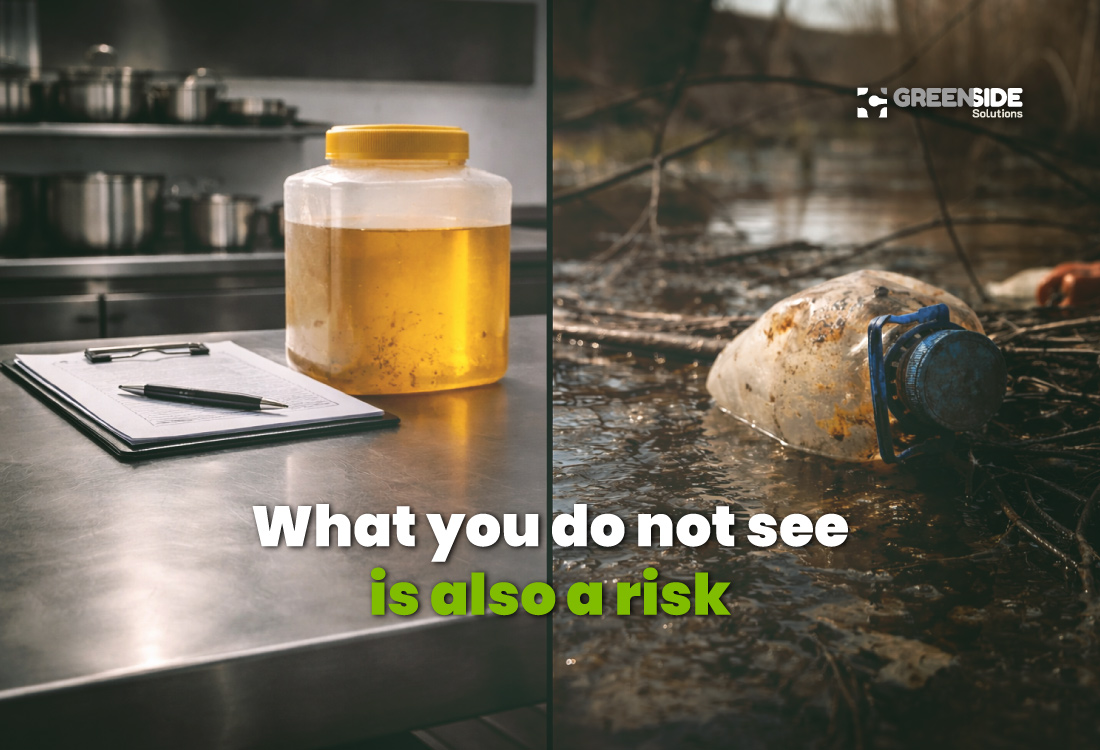
In the case of used cooking oil, for example, improper disposal creates a film on the surface of the water that prevents oxygen exchange and disrupts ecosystems.
This process does not only affect the natural environment. It can also:
- hinder the operation of wastewater treatment plants
- cause blockages in sewer networks
- increase treatment costs
These are silent effects, but persistent ones.
And in many cases, they are irreversible in the short term.
The risk no one mentions: when you cannot prove it
This is where most companies fail.
Not in the act of managing waste itself.
But in their ability to prove it.
Because today, doing things properly is not enough.
You need to be able to demonstrate it.
In an audit.
To a client.
In a certification process or ESG report.
When there is no clear documentation, data or traceability, a real problem appears:
you cannot prove what happened to your waste.
And that implies:
- reputational risk
- regulatory non-compliance
- loss of control
This connects directly with what we already explained in articles such as final destination of waste, where the key is not only to manage waste… but to know exactly where it ends up.
From waste to corporate responsibility
For years, waste management was seen as an operational obligation.
Today, it is no longer just that.
It has become a strategic issue.
Because it affects:
- the company’s real sustainability
- its ability to report
- its positioning with clients and partners
And, above all, its level of control.
A company that does not know the full journey of its waste is not really managing it. It is delegating without visibility.
How to move from waste management to real control
The change does not come from collecting more waste or changing providers.
It comes from how information is managed.
To move from basic management to real control, a company needs:
- to know the origin and volume of its waste
- to have access to updated data
- to have verifiable documentation
- to understand its environmental impact
This is where tools such as environmental dashboards make it possible to turn data into decisions.
Because when you have visibility, you have control.
And when you have control, you reduce risk.
Waste management is not measured by what you remove, but by what you can prove.
Conclusion
What cannot be seen still matters.
And in waste management, it is often the most important part.
It is not just about complying.
It is about understanding, controlling and being able to prove every part of the process.
Because the difference between managing waste and managing it well does not lie in collection.
It lies in everything that happens afterwards.